The Architecture of a Winter Covenant
The night the transmission crackled to life, the blizzard had already begun to dismantle the very idea of a city. It was one of those Great Lakes gales that didn’t just descend from the atmosphere but seemed to erupt from the frozen pavement, a white, spiraling madness that erased the distinction between the sky and the earth. Snow packed itself into the jagged fissures of the abandoned industrial district, smoothing over the jagged edges of broken glass and the rusted skeletons of chain-link fences that guarded nothing but ghosts. By the time the clock struck two in the morning, the neighborhood of Oakhaven felt like a memory being buried under a heavy, suffocating shroud of white.
Elias Thorne had worn the badge long enough to recognize the particular frequency of a midnight dispatch during a state of emergency. Calls at that hour, whispered through the static of a storm that could freeze a man’s lungs, never heralded anything but the grim and the difficult. “Possible animal attack in progress,” the dispatcher’s voice had hummed, sounding thin and metallic against the wind howling outside the cruiser. “Vacant tenement on Tenth and Willow. Caller reports a large, aggressive canine. Sounds of a struggle. Multiple screams heard from the interior.”
Elias didn’t care for the clinical finality of the word “aggressive” when it was applied to a creature that hadn’t been seen yet. In his experience, that label was usually a verdict passed by the fearful before the evidence had a chance to speak.
His partner, Sarah Miller, kept her eyes locked on the faint, flickering tail lights of the world as the cruiser crawled through streets that looked like they hadn’t seen a tire track in a decade. “Have you ever noticed,” she murmured, her knuckles a pale ghost-white against the steering wheel, “how these calls always seem to originate from the places the city has already decided to forget?”
Elias watched the skeletal remains of the neighborhood slide past—windows boarded up like blind eyes, porches sagging under the weight of rot, doors hanging open like mouths waiting for a scream. “Yeah,” he replied, his voice a low rumble. “The places no one looks at. Until they have a reason to be afraid.”
The Sentinel in the Shadows
They were forced to park nearly a block away because the drifts had become insurmountable walls of ice. The moment Elias stepped out, the wind struck him with the force of a physical blow, sharp enough to peel the warmth from his skin in a heartbeat. Somewhere in the churning white, a loose piece of sheet metal clanged against a brick wall, a rhythmic, lonely percussion that sounded like a funeral bell.
The house they approached was a jagged silhouette of neglect. The front steps had surrendered to gravity years ago, and the front door hung crooked on a single rusted hinge, groaning in a low, agonizing cadence every time the wind shoved its way inside. Elias drew a slow, deliberate breath, his gloved hand coming to rest near his service weapon as a matter of habit. “Keep your eyes moving, Sarah. Let’s not stay here longer than we have to.”
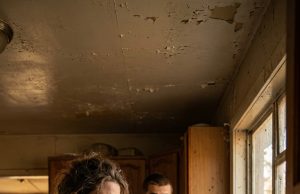
Inside, the cold was a stagnant, suffocating presence, as if the house had been inhaling the winter and refusing to breathe it back out. The air carried the sharp, biting scent of old dust, wet insulation, and a faint, metallic tang that Elias recognized as the smell of survival. Their flashlights carved narrow, trembling tunnels through the darkness, catching the wreckage of a life long ago abandoned: a disemboweled sofa, a shattered ceramic lamp, and fiberglass insulation spilling from the walls like the exposed nerves of a dying beast.
“City Police!” Sarah called out, her voice bouncing and echoing in the hollow architecture. “If there’s an owner here, control your animal now!”
For a long minute, there was nothing but the sound of the wind whistling through the shattered windowpanes. Then, a vibration began—a sound so low and deep it seemed to resonate in the floorboards beneath their boots. It wasn’t a bark; it was a warning.
Elias snapped his beam toward the far corner of what used to be a parlor, and for a second, his mind struggled to make sense of the geometry of the scene. The dog was immense—a dense, barrel-chested pit bull mix built from solid muscle and ancient, unyielding instinct. His coat was a matted map of grease and grime, his ribs tracing a skeletal path beneath skin stretched too thin. Scars, some silver and old, others raw and angry, crisscrossed his face and shoulders. His left ear was a jagged remnant, as if a piece of his history had been torn away.
And beneath him—pinned between those massive, scarred paws—was a small, motionless shape of gray fur.
“Lord,” Sarah whispered, her thumb hovering over the safety of her taser. “He’s got something. He’s tearing it apart.”
The Revelation of the Heart
It looked like a crime scene at first glance—dark, uneven patches of crimson smeared against the gray floorboards. The dog lifted his head with agonizing slowness, his lips curling back just enough to reveal white fangs. But he didn’t lunge. He didn’t growl with the intent to hunt. Instead, he shifted his weight with a strange, deliberate grace, angling his massive body into a living barricade between the officers and the creature beneath him.
He wasn’t trapping it. He was shielding it.
Elias felt a sudden, inexplicable tightening in his chest. “Hold your fire, Sarah,” he said, his voice coming out as a strained whisper. “Wait.”
“One more step and I’ll have to drop him!” Sarah called out, her voice steady but high with adrenaline.
The dog froze. He didn’t flinch in fear, but he hesitated, his amber eyes catching the harsh glare of the flashlight. In that split second, Elias didn’t see the rage of a predator. He saw a profound, bone-deep exhaustion—the kind of weariness that comes from holding the line for too long against a world that never stopped attacking.
Then the dog did something that defied every assumption the officers had brought into the room. He lowered his head and began to lick—quick, rhythmic, urgent movements—at the small gray shape nestled between his paws. He wasn’t biting. He was grooming. He was warming. He was reminding the thing beneath him to keep breathing.
Elias took a step closer, his boots crunching on the frozen grit. Sarah didn’t stop him, though he could feel the shift in her energy as confusion began to overtake her certainty. The light reached the corner fully then, and the scene reassembled itself into a truth that made the cold feel even sharper.
The blood wasn’t coming from the small animal. It was coming from the dog.
His paws were raw and split, the pads torn from digging through the ice and the rubble, leaving a trail of red and pink where he had dragged himself to this corner. The floor wasn’t a crime scene; it was a sanctuary.
Beneath the dog lay a cat, barely more than a frame of bones wrapped in thin gray fur. One of its eye sockets was a closed vault of scar tissue; the other was a clouded, milky orb that saw nothing. The cat’s body was racked with a faint, rhythmic tremor, the unmistakable sign of a life losing its grip on the light. Around them, scraps of moldy insulation and shredded yellowed newspapers had been painstakingly gathered into a rough, circular nest.
“Don’t move,” Elias said again, but the command had softened into a plea.
The dog remained perfectly still, his chin resting protectively over the cat’s neck. Slowly, Elias crouched down, lowering the intensity of his light. “He’s freezing to death,” Sarah murmured, her voice finally breaking.
Elias nodded. “And that dog is the only reason he’s still a living thing.”
The Burden of the Broken
The rescue was conducted in a hushed, reverent silence. Sarah retrieved a heavy wool blanket from their emergency kit, while Elias spoke in low, grounding tones. He wasn’t sure if the dog understood the linguistics of the English language, but he hoped the animal recognized the frequency of mercy. “It’s okay, big guy. We aren’t here to take him away. We’re going to help you both.”
The dog watched every micro-movement, his muscles coiled like a spring, yet he remained controlled. When Elias reached out a hand, the dog tensed for a heartbeat—then stepped back just enough to allow the intervention. It wasn’t a surrender; it was a leap of faith, given with a profound reluctance.
They lifted the cat first, wrapping him in the warmth of the wool. The dog followed immediately, pressing his shoulder against Elias’s leg, refusing to let even a shadow of distance grow between them. By the time they loaded them into the heated transport van, the blizzard seemed to have doubled its fury, as if the elements were trying to drown out the memory of what had transpired in that hollow house.
Elias sat in the passenger seat, staring into the rearview mirror at the rear compartment where the dog lay, his heavy head resting near the carrier that held the cat. “Have you ever seen anything like that in your life?” Sarah asked quietly as they pulled away.
Elias shook his head. “No,” he said. “I think we just spent the last hour misunderstooding the most important thing in the world.”
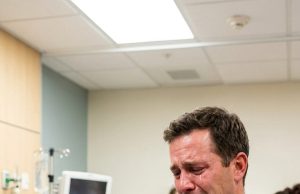
The municipal animal shelter was a place of white tile, harsh fluorescent hums, and a clinical detachment that felt more abrasive than the storm. The intake supervisor didn’t even look up from his clipboard as they entered. “Pit bull mix?” he asked, his pen already scratching out a form. “Large breed. Report says aggressive?”
Elias hesitated. “Protective,” he corrected firmly.
The man didn’t flinch. “Policy says we separate them for medical evaluation. Standard procedure.”
“No,” Sarah interjected, her voice sharp. “You don’t understand the dynamic—they can’t be—”
“Policy,” the supervisor repeated, his tone flat and final.
And just like that, the fragile covenant was fractured. The moment the dog—whom the staff began calling Barnaby, though the name felt too small for him—was led away, the sound he released wasn’t a bark. It was a jagged, high-pitched keening, a sound of such human-like desperation that it made the intake nurses turn away. In the isolation ward, the cat—labeled “Milo” on a plastic tag—curled into a tight, shivering ball and simply stopped responding to the world.
The Recognition of Old Souls
By the next morning, the clinical policy was reversed by the shelter’s lead veterinarian, not out of a sense of sentimentality, but because it was clear that Milo was choosing to fade away without the anchor of his protector. When they finally opened the kennel door, Barnaby didn’t run. He crawled on his belly, whining softly, until he reached Milo’s side. When the cat felt the warmth of the dog’s fur, he lifted his head and let out a weak, rattling purr—the sound of a heart trying to find its rhythm again.
Weeks turned into a month. Potential adopters came and went. They gravitated toward the puppies with clear eyes and uncomplicated histories. They looked for the easy stories, the ones that didn’t come with scars or a requirement for specialized care. Barnaby and Milo waited in the shadows of the back kennels, two ghosts in a room full of noise.
Until the afternoon an older man named Silas Vane walked through the double doors. He was seventy-three, a retired machinist who walked with a heavy mahogany cane and carried the silence of a widower who had spent too many years in a house that was too big. He didn’t say a word at first. He just stood in front of the kennel, watching.
He watched the way Barnaby nudged his own water bowl toward Milo before taking a drink himself. He watched the way Milo would reach out a fragile paw, constantly checking to ensure the dog was still within reach. Silas leaned on his cane and let out a long, weary breath. “Yeah,” he muttered to himself. “I know exactly what that look feels like.”
When the shelter staff tried to warn him about the dog’s “complex history” and the cat’s permanent disability, Silas simply shook his head. “You’re telling me this animal is too much work?” Silas asked, looking the young volunteer in the eye. “Son, I spent four decades fixing machines that people told me were only fit for the scrap heap. I’ve never seen anything truly broken that didn’t have a reason for it.”
He tapped the glass of the kennel gently with a gnarled finger. Barnaby stood up and stepped forward, pressing his scarred muzzle against the barrier. For a moment, it was just two old souls recognizing the map of each other’s battles.
“My house is too quiet,” Silas said, his voice softening. “It’s a hollow place. I think we could all use a little company.”
He looked at the cat, then back at the dog who had refused to let it die. “In my world, nobody gets left behind because they’ve got a few marks on them.”
The Vigil in the Quiet House
The transition to Silas’s small, neat home on the outskirts of the city wasn’t a cinematic triumph. It was a slow, deliberate process of learning how to trust the silence. Silas understood that Barnaby didn’t need a master; he needed a partner. Milo didn’t need a cure; he needed a safe harbor.
The real reckoning occurred three months later. It was a Tuesday evening, and a neighbor’s poorly aimed cell phone video of Barnaby barking at a delivery driver had gone viral under a headline about “Aggressive Breeds in the Suburbs.” The digital world, quick to judge and slow to listen, had begun to howl for removal. Silas had spent the morning on the phone with the homeowners’ association, his voice growing hoarse as he defended the dog’s right to exist.
But that night, the world narrowed once again to the space inside four walls. Silas had suffered a silent stroke in the hallway, his body collapsing against the baseboard, his voice stolen by the sudden neurological storm. He lay there in the dark, unable to move, unable to call for the help that was only a few feet away.
Barnaby didn’t bark at the door. He didn’t pace the room in a panic. He moved to Silas’s side and began to do what he had done in that frozen tenement months ago. He pressed his massive, warm body against the man’s chest, providing the heat that a failing system could no longer generate. He nudged at Silas’s hand, licked his face with an insistent, grounding pressure, and refused to let the man slip into the dangerous sleep of the dying.
While Barnaby held the line, Milo sat on Silas’s shoulder, his rattling purr providing a constant, vibrating anchor for the man’s drifting consciousness. It was two hours before the neighbor, coming over to apologize for the HOA drama, heard the muffled, persistent whining from the hallway and called the paramedics.
When the emergency crew arrived, they found a scene that no viral video could ever capture. A “dangerous” dog and a “broken” cat were the only things keeping an old man’s heart beating in the silence.
But this story isn’t about proving the world wrong. It’s about something far more durable than an argument. It’s about the kind of loyalty that doesn’t require a witness or a headline to be real.
In the end, Barnaby wasn’t a monster. Milo wasn’t a tragedy. And Silas Vane was no longer a forgotten man in a quiet house. They were, in the only way that has ever mattered, a family.