Bloodlines and Bonds
Part 1: The Long Shadow of Infertility
For the longest time, I lived under the heavy assumption that no pain could match the agony of a nursery left empty year after year. I had reached a point where I believed that chapter of my life was firmly closed, resigned to a quiet kind of grief. But just as I began to accept a childless future, a bizarre sequence of events forced me to redefine everything I thought I knew about family.
I had lost count of the times my spirit broke.
In the beginning, I was meticulous. I cataloged every medical consultation, memorized every lab result, and analyzed every success margin the reproductive endocrinologists threw our way. Eventually, though, the statistics lost all meaning. All I knew was a cruel, repetitive pattern: every single time motherhood felt within my grasp, it dissolved into nothingness.
Yet, through every dark hour, Daniel never wavered.
He was my anchor in those sterile waiting rooms. He took the wheel on the silent, heavy drives home after devastating appointments. When words failed us entirely, he simply held my hand, letting me know I wasn’t alone in the dark.
We exhausted every avenue. There were endless diagnostic panels, avant-garde therapies, and a suffocating, hyper-scheduled existence that dictated our intimacy and our lives.
Nothing worked. After a succession of agonizing miscarriages, the emotional toll became too great. I was on the absolute precipice of burying my dream for good.
Then, a random Tuesday evening shifted our trajectory.
Part 2: A New Path Forward
We were washing the dinner dishes in silence when Daniel turned to me, a quiet intensity in his eyes.
“What if we look outside ourselves?” he suggested softly.
I knew exactly what he was implying. Years ago, in the infancy of our fertility struggles, we had briefly touched upon the idea of gestational surrogacy. Back then, we dismissed it; the legal and emotional complexities felt too daunting.
But that night, the hesitation was gone. Instead of retreating from the topic, we dove into it headfirst. We stayed up until dawn dissecting the possibilities.
What would it feel like? What were the legal vulnerabilities? Could our marriage survive another crushing blow if this failed too?
For the first time in a decade, a conversation about children didn’t end in tears or heavy silence. It ended with a pact. We were going to try one last time.
Part 3: Meeting Mara
We navigated the preliminary stages with extreme caution. Our lives became a blur of agency interviews, reproductive attorneys, and third-party coordinators. We were handed thick dossiers bound in cold legalese, requiring us to answer deeply personal questions. Daniel scrutinized every clause twice, while I went through the pages with a yellow highlighter, questioning anything that felt ambiguous.
By the time the final contracts were executed, every boundary was clear.
Our gestational carrier was a woman named Mara. She possessed a grounded, serene demeanor that immediately put our anxieties to rest. She was incredibly kind, and from the very first embryo transfer, the pregnancy progressed flawlessly.
To be honest, the perfection of it terrified me. I had been conditioned by trauma to expect a catastrophe around every corner, so I spent the first trimester waiting for the other shoe to drop.
Then came the initial viability scan.
The sonographer adjusted the contrast on the monitor, a warm smile breaking across her face. “Take a look right here.”
A microscopic, rhythmic pulse flickered on the monochrome screen. I hadn’t even realized I was sobbing until Daniel compressed my hand, leaning in to whisper, “We made it. It’s real.”
And for the very first time, it actually felt possible.
Part 4: Welcoming Lily
As the trimesters flew by, every medical update was a celebration. Every genetic screening came back clear; every milestone was met with textbook precision. Gradually, the defensive armor I had worn for years began to crack. Daniel and I finally permitted ourselves to assemble a crib, pick out soft pastel wallpaper, and debate a list of names.
The day our daughter entered the world felt entirely sacred. The delivery suite was bathed in a soft, calm glow.
Then, the silence was shattered by a robust, indignant wail.
“We have a healthy baby girl,” the doctor announced cheerily.
Seconds later, a swaddled bundle was placed gently against my bare skin. My daughter. Lily.
She was warm, impossibly small, and utterly flawless. Daniel leaned over my shoulder, his voice thick with emotion as he murmured, “Look at what we did. She’s beautiful.”
I didn’t close my eyes once that night. It wasn’t exhaustion keeping me awake; it was an intoxicating, unfamiliar rush of pure peace.
Part 5: The Silent Terror
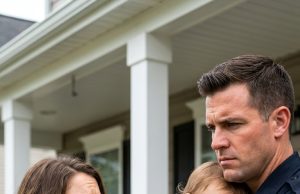
The following afternoon, the atmosphere of celebration fractured entirely. Daniel and I had returned to the maternity room, accompanied by my mother, Susan. She had been our emotional rock through every failed cycle and devastating loss. Hearing her proud voice echo in the corridor brought a massive smile to my face.
She walked into the room, her eyes instantly landing on Lily’s clear plastic bassinet.
“Let me see my granddaughter,” my mother said softly, leaning over the mattress.
But as she peered down at the baby, she completely froze.
The joyful expression vanished from her face, replaced by a sudden, hollow blankness. Every ounce of color drained from her skin as she stared at the infant for what felt like an eternity.
A cold knot formed in my stomach. “Mom?” I prompted.
Silence.
“Mom, you’re scuffing me. What’s wrong?”
When she finally spoke, her voice was a fragile, trembling whisper. “Claire… you cannot take this baby home.”
Part 6: The Mark
The room felt as though the oxygen had been vacuumed out of it.
“What did you just say?” I breathed.
Daniel instantly stepped away from the window, his posture turning defensive.
My mother looked utterly paralyzed—not with anger or disapproval, but with a visceral, deep-seated terror.
“Please,” she pleaded, her hands shaking. “Turn her head. Look behind her left ear.”
I knit my brows together. “What are you talking about, Mom? She’s perfect.”
“Just look at her, Claire. Please.”
The raw desperation in her tone overrode my confusion. Gently, I lifted Lily from the bassinet, cradling her head and tilting it slightly to examine the soft skin behind her earlobe.
There, nestled near the hairline, was a distinct, crescent-shaped hyperpigmentation.
“It’s a birthmark,” I stated, trying to rationalize the situation. “Lots of babies have them.”
“No,” my mother countered, her voice cracking. “Not that one. Not in that exact shape.”
Daniel closed the distance between us. “What is the significance of a birthmark, Susan?”
My mother swallowed hard, staring at me with wide, haunted eyes. “Claire, you were born with that exact same crescent mark.”
I stared back at her, completely uncomprehending. “What?”
“You were an infant when we had a pediatric surgeon remove it. It faded into nothing. You have no memory of it.”
A cold dread began to crawl up my spine. “What does my medical history have to do with the baby Mara carried for us?”
My mother took a long, stabilizing breath. “Because I think a catastrophic error occurred at the lab.”
Part 7: Ghosts of the Past
My mother guided me out of the room and into a secluded family lounge down the hall. For a long time, she just stared at her intertwined fingers.
Finally, she broke the silence. “Decades ago, before you were born, your father and I hit rock bottom financially. We were on the verge of losing everything.”
I remained silent, waiting.
“There was an experimental fertility program at the university clinic. They were offering substantial compensation for anonymous egg donors.”
The revelation hit me with physical force. “You were an egg donor?”
She nodded slowly, a tear escaping her eye. “It was completely anonymous. I was young, desperate, and I never imagined a scenario where it would resurface. But I kept tabs on the facility over the years. I knew that a handful of children had been conceived from those specific cycles.”
My heart was hammering against my ribs like a trapped bird. “What are you implying, Mom?”
“That specific crescent mark appeared in two of the children born from my donations back then,” she whispered. Then, she uttered the words that fractured my reality: “Claire, I think Lily was conceived using one of my frozen eggs from thirty years ago.”
Part 8: Audit Trails
That very afternoon, Daniel and I turned our hospital room into a command center. We pulled up every digital document associated with our IVF and surrogacy journey. Contracts, chain-of-custody forms, laboratory emails, embryology reports—we analyzed every line.
Initially, the digital paperwork seemed airtight. But then, Daniel’s scrolling stopped abruptly.
“Claire,” he said, his voice dropping an octave. “Look at the cryopreservation log.”
I leaned over his shoulder, focusing on a routine laboratory audit sheet from the embryology lab. Near the bottom, buried under technical jargon, was a handwritten notation dated the morning of our embryo transfer:
Lot #442-A re-indexed prior to thaw protocol.
My stomach violently churned. “What does that mean in plain English?”
Daniel’s face was grim. “It means the inventory system was altered right before they prepared the embryo for Mara.”
Part 9: The Laboratory Inquest
At 9:00 AM the following morning, we bypassed the reception desk and demanded an immediate audience with the medical director of the fertility center.
The moment Dr. Harris walked into the consultation room, his defensive posture confirmed our worst fears.
“We’ve been running an internal audit on your file since you called yesterday,” he began, bypassing any pleasantries.
“Why was an audit necessary?” Daniel demanded, his voice dangerously calm.
Dr. Harris ran a hand over his face, looking exhausted. “There was a major inventory reconciliation error in our long-term cryogenic storage facility.”
The walls of the room felt like they were closing in on me. “What kind of error, Doctor?”
He looked at me with genuine remorse. “During a global database migration last autumn, several older, grandfathered tissue samples were re-labeled. We have reason to believe that the embryo transferred to your gestational carrier did not originate from your harvested eggs.”
For a few seconds, the room went entirely dark. I couldn’t find my breath. “No,” I whimpered.
Dr. Harris plowed on, trying to soften the blow with clinical terminology. “An obsolete batch of anonymous donor eggs from the late 1990s was miscategorized during the software update. There is a high probability that an embryo from that legacy batch was mistakenly selected for your cycle.”
Daniel stood up, his chair scraping violently against the floor. “And you let my wife go through a year of emotional purgatory without disclosing a systemic failure?”
“We were trying to confirm the genetic discrepancy before causing panic—”
“You owed us transparency the second that tissue was compromised!” I shouted, my voice cracking with a mixture of grief and fury. Then, I forced out the only question that truly mattered: “If she isn’t genetically mine… whose baby is she?”
Dr. Harris looked down at his desk, shaking his head. “We are still mapping the legacy donor logs. We don’t have a definitive identity yet.”
Part 10: The Sovereign Choice
When we walked back into the hospital room, my mother was cradling Lily. The clinic’s executive team had already phoned her, confirming the administrative nightmare.
Suddenly, our world was invaded by outside noise. Hospital administrators, family lawyers, and risk-management coordinators wanted to schedule emergency syncs. They spoke in cold, detached terms: disposition protocols, liability mitigation, and corrective custody frameworks.
To them, Lily was a catastrophic insurance liability—a broken equation that needed to be balanced.
But when I looked at her, I didn’t see a laboratory error. I didn’t see a mix-up of genetic coding.
She wasn’t a problem to be solved. She was my child.
Three days later, we sat across from Dr. Harris for the final time, our family attorney by our side.
“In the event that a biological claimant from the legacy database steps forward to dispute the maternal lineage—” Dr. Harris began cautiously.
“We are not entertaining a custody dispute,” I cut him off, my voice sharp and unyielding.
The room fell into an abrupt, tense silence.
Daniel reached across the table, weaving his fingers through mine, reinforcing my stance. “Lily is our daughter,” he stated with absolute finality. “The biology is irrelevant. The lineage is settled.”
Dr. Harris searched our faces for any sign of hesitation. Finding none, his shoulders dropped, and he gave a slow, respectful nod. “Understood. We will structure our legal defense accordingly.”
Part 11: DNA vs. Motherhood
A month later, the frantic pace of the crisis finally dissolved into the quiet routine of newborn life.
One evening, the house was dark save for a single floor lamp in the nursery. My mother stood quietly by the window frame, watching me slowly rock Lily to sleep in the armchair.
After a long, reflective silence, she spoke. “I was entirely wrong, Claire.”
I looked up, the rhythmic creaking of the rocker the only sound between us.
She offered a small, bittersweet smile. “When I saw that mark, I panicked. I was terrified that a hidden piece of my past was going to dismantle the life you and Daniel fought so hard to build. I thought the only way to protect you was to walk away from her.”
A fresh wave of tears stung my eyes.
Susan stepped closer, reaching down to gently stroke Lily’s downy hair, her gaze soft and reverent. “But watching you with her this past month, I’ve realized something profound.”
She looked directly into my eyes. “The motherhood didn’t happen in a petri dish, Claire. You became her mother the exact second you looked at that flickering screen months ago and chose to love her unconditionally.”
I looked down at the tiny miracle sleeping in my arms. I looked at her miniature fingers curled against my shirt, her soft, rhythmic breathing, and the tiny crescent mark behind her ear that had briefly ignited a firestorm.
And then, I finally smiled.
Because my mother had spoken the absolute truth. There was no amount of clinical documentation, no genetic sequencing report, and no laboratory malpractice that could ever touch the invisible, bulletproof cord that bound my heart to hers.
Lily was our daughter. And nothing in this world could change that.